Why These 4 Questions Shape My Daily Journaling Practice

Other Platforms Apple Podcasts | Spotify | RSS | More Destinations
I’ve been journaling more or less daily for the past fifteen years.
As much as I love the romantic vision of pen on paper, I’ve always done it digitally because I could never keep up with a handwritten journal. I tried, but it never really worked.
Over the years, I’ve come across plenty of advice on the best ways to journal, the best techniques, and the best prompts. I always think it’s worth bringing a bit of nuance to these conversations because, as far as I’m concerned, the best way to journal is whatever way means you actually do it. And that depends entirely on who you are, what you want your journal to do for you, and how it fits with your life circumstances.
In this episode of The Gentle Rebel Podcast, I discuss something I recently noticed about my journal practice that I’d never considered before.
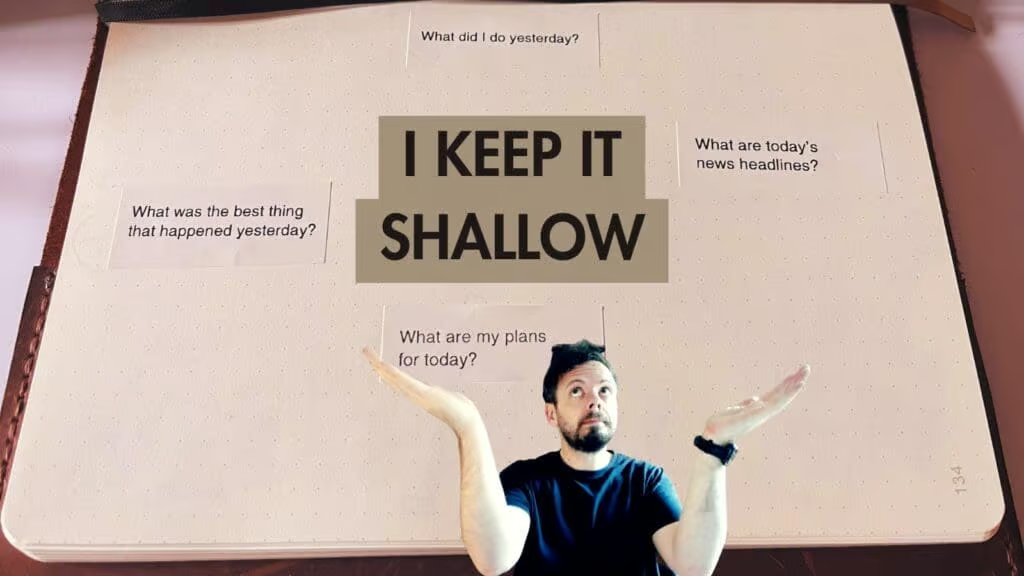
Since 2021, I’ve been answering the same four questions most mornings:
- What did I do yesterday?
- What was the best thing that happened yesterday?
- What are today’s news headlines?
- What are my plans for today?
What struck me is that all four questions are surprisingly objective and focus on facts rather than feelings. They’re concrete, and none of them explicitly probe beneath the surface.
They don’t want me to go searching for deeper meaning. Just record, archive, and document. If I’m short on time, I can answer the questions in less than five minutes (once I’m able to recall what happened yesterday). They are simple, easy, and objective. But more often than not, I go deeper and longer. Especially once I start thinking about the best thing that happened yesterday, today’s news headlines, and what I have planned.
Recording and Processing
The reason I started thinking about all this was that I saw a post on social media titled “How Journaling Actually Works.” It suggested that people get journaling wrong by recording events like a diary rather than finding the meaning in them. It caught my attention because it was the opposite of what I’ve found to be true.

He suggests asking yourself questions like:
What does this situation actually mean to me and why does it feel the way it does?
Whoa, where do you start with that?
- What am I avoiding thinking about right now?
- What am I pretending is fine when it’s not?
- What would I do if I were not afraid of the outcome?
These are reasonable coaching-style questions for addressing specific situations. But they demand a fairly high cognitive and emotional load and likely require more than the five honest minutes he suggests for meaningful insight.
If those are the kinds of questions you’re asking every time you sit down to journal, it can start to feel like a pretty heavy-duty habit. I don’t know about you, but I would feel resistance to picking up my journal if that was what confronted me.
My experience has been quite different.
Over fifteen years of journaling, I’ve found that recording often opens the door to processing.
The simple act of documenting what happened yesterday gets my mind moving. It gives me something to work with. And sometimes, while writing about ordinary things, I stumble into something much bigger.
Recently, during one of our Haven Journal Circles, I responded to the prompt: What brought me peace this week?
My answer was having the brakes replaced on my car. A fairly ordinary response.
But when I wrote a little more about it in my journal the next morning, it opened up a whole bunch of things I wanted to explore, not least of which was putting off doing something I know needs doing. It prompted me to stop procrastinating several other things that have been draining me in the background for a while.
I didn’t sit down intending to write about avoidance, and I wouldn’t have thought about it in relation to those other questions. It was when I considered something present for me (peace) that I could see what was missing.
That’s one of the things I love about this style of journaling. I never quite know what might occur.
Why These Four Questions Work For Me in My Journal Practice
Interestingly, I used to have more reflective questions in my daily practice. For a while, I asked things like:
- What am I thankful for right now?
- What does this make possible?
- What one thing that is not urgent but important will I do today?
These aren’t bad questions. But over time I found them difficult to answer consistently. My engagement with them became repetitive, and they started to feel a little burdensome.
What did I do yesterday?
This question is a helpful anchor. It’s shocking how easily I forget what I did just twenty-four hours ago.
I regularly underestimate how much I’ve done and how far I’ve come. I adapt to changes quickly and can lose sight of progress that would have seemed significant only a few days or weeks earlier.
Recording what happened yesterday helps me notice that movement.
What was the best thing that happened yesterday?
This question was an iteration of “What am I thankful for right now?”
I realised that I didn’t find it helpful to ask what I’m grateful for. Because some days I don’t FEEL grateful when I sit down to write. But there is always a best thing relative to everything else that happened yesterday. And through responding to that question, a feeling of gratitude, appreciation, or satisfaction often follows.
The best thing doesn’t need to be a great thing. It can simply be the best among a collection of difficult things.
What are today’s news headlines?
This is very much a personal choice because I like anchoring myself in cultural time. When I look back through old entries, it’s fascinating to see what was happening in the wider world alongside whatever was happening in my own life.
It’s easy to lose track of timelines and current events. Recording headlines provides context for personal reflections and sometimes reveals connections I wouldn’t have noticed otherwise.
That said, I wouldn’t suggest everyone does this. For some people, there may be good reasons not to engage with the news during a journaling practice.
You might choose to record the weather, books you’re reading, films you’ve watched, or something else entirely. The principle is similar because these things can influence us without us necessarily noticing at the time. And by recording and archiving regularly and consistently, these pictures can become clearer.
What are my plans for today?
This question took a little tweaking.
I used to ask, “What will I do today?” As a way to commit myself to particular actions. But eventually realised that wasn’t quite right because my days often contain things I didn’t plan. Plans change, and unexpected things happen.
If plans are framed as things I will do, it can feel like a failure if I don’t carry them out. But by asking about my plans rather than what I will do, I can set intentions for the day and later notice how closely reality matched what I anticipated. That neutral observation doesn’t need to become a judgment or source of self-criticism.
My relationship with plans has definitely softened. Maybe because of this. Or maybe I approach plans this way because I hold them differently.
Building Your Own Journaling Practice
One thing that stood out to me in the social media post was the suggestion that consistency matters less than honesty.
I understand the point being made, but for me consistency has been a key pathway TO honesty. And inconsistency would yield something more performed or forced.
Keeping a journal creates an ongoing conversation. Over time it builds familiarity, trust, and reliability. The bigger thoughts and feelings have somewhere to go when they appear because the habit already exists.
Not all journal sessions become deep dive self-examinations. Some do because most don’t.
The post drew a distinction between recording and processing, and between shallowness and depth. But in my experience, the two are closely connected. Recording often creates the conditions where reflection can emerge.
What Do You Want Your Journal Practice To Do and Be For You?
Pay attention to how different questions make you feel. If you’re building a practice, ask yourself what you want it to be. Enjoy experimenting with it. Don’t be afraid to reject advice or to let go of questions that run out of road. It’s your practice, and it needs to work for you.
The four questions I use today emerged through years of tweaking, adapting, and noticing what keeps me coming back with energy and enthusiasm.
Your journal practice will probably look different. And that’s exactly as it should be. But maybe this is where you can start. Try these questions, tweak them, add your own, and pay attention to your relationship with the practice.
Pick The Lock
Do you want help thinking about this? It’s a good fit for a Pick The Lock call, which is a one-off 60-minute, choose-your-own-price session designed to give you a sounding board for a challenge, goal, or change you’re considering.
Send me a message, or learn more here.

Journal Circle
If you would like some low-stakes, simple prompts to try things out, join us in The Haven. Every Friday we have our journal circle, where we meet for 30 minutes, reflect on the shape of the past seven days, and do a simple five-minute written exercise in response to a question. After that, we have space to chat about how we got on.