When People ASSUME They Know You – Variety & Neurodiversity

Other Platforms Apple Podcasts | Spotify | RSS | More Destinations
In this episode of The Gentle Rebel Podcast, we explore the variety of neurodiversity.
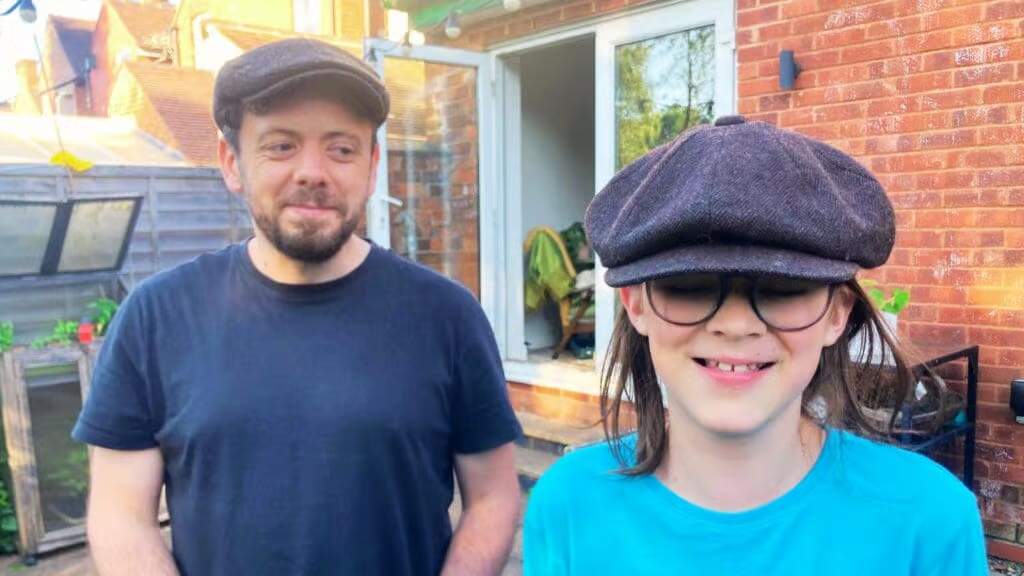
I’ve been staying with friends over the past few weeks, including Lucas, who is nearly 12. He is autistic, and after spending time trawling through the Gentle Rebel Podcast episode archive, we had a chat about topics he thought would be good to explore.
One of those topics was what he described as “the variety of neurodiversity”. When I asked what that meant to him, and why he felt that was an important thing to discuss, he said that it’s important to realise that not all neurodivergent people have the same needs or preferences.
It can be frustrating for him when people make assumptions because of his autism, confusing one person’s experience as being true and applicable to everyone.
It reminded me of the story I’ve told a few times on the podcast, when I shared that I love horror films and someone responded by saying it meant I wasn’t a highly sensitive person (HSP). Fortunately, I met a bunch of fellow HSP horror fans who were very grateful to discover they were not alone in that love and passion. It was a really nice reminder that we are all different.
There is no one-size-fits-all approach to our natural variations, and while brains share characteristics across neurotypes, our needs, preferences, and tastes are a more complex mix of genetics, environment, and psychology.
13 Questions
I created a mini-zine for Lucas to answer some questions about this topic, which I share in the episode. He has given me permission to talk about his responses because we hope this can help people feel a bit safer and more confident being themselves, even if it makes them different. And for those listening who spend time with neurodivergent people, we hope this encourages them to see everyone as an individual rather than making assumptions that they would be the same as others they’ve met, or as themselves.
I would also love to invite you to share your own responses to these questions. I’ve created a survey because I’d be really interested in gathering a variety of responses and getting a sense of the variety of neurodiversity.
Can you remember a time when someone assumed something about you because you were autistic? What did they get wrong?
Before moving to be educated at home, Lucas had noticed adults assuming that he was like the other autistic children at the school. The teachers assumed he found it difficult to learn, but in Lucas’s case, he found it difficult to be at school.
Having spent a lot of time with the family over the past five years, I’ve seen this radical shift as he has transitioned from that institutional school setting to home-based education and is absolutely blossoming. In a way, it feels frustrating that the teachers who had all but written him off through those assumptions will likely never see it. He loves learning, is a sponge for knowledge, and embraces the joy of connecting the dots across a vast range of subjects.
What do people tend to misunderstand most about neurodivergent people?
“Sometimes people think we’re all the same”, Lucas replied to this one. “They assume that ADHD people are naughty, but actually our brains have so much to focus on so it’s hard to listen.”
“Naughty” is a judgement based on the person making it (and the context they are in). In many situations not designed for different types of brains, when people are unable to focus, respond as expected, or do so at the correct speed, authority figures may ascribe intent to those actions. This underpins the disadvantage faced by those expected to play by rules that impose a heavy cognitive load. This can prevent them from functioning and flourishing in their natural way.
Have people ever tried to help you in a way that actually made things harder? What did they do?
I didn’t ask this question to make people with good hearts feel bad. But because it sits at the heart of much of this stuff, and I’ve heard countless stories of kids being ignored by those who think they know what’s best for them. Lucas described how his needs were ignored by the adults at school.
We know about the role of differential susceptibility from the ever-growing body of research around environmental sensitivity. Vantage Sensitivity indicates that the more sensitive someone is, the more positively they are affected by a safe and supportive environment. Diathesis Stress shows that the more sensitive a person is, the more they’re negatively affected by stressful conditions.
The school setting can be stressful for neurotypes with diverse sensitivities whose nervous systems don’t naturally fit the normalised environment.
Do you know autistic people who are very different from you? How are they different?
Lucas said yes to this because, for example, some autistic people he knows are more confident when speaking. Those whose brains function in similar ways still have different personalities, tastes, and abilities.
It can be encouraging to see people with the same neurotype who are also different, because it inspires us to believe we’re not necessarily limited or restricted, especially when those limits or restrictions are imposed by unfair assumptions and unfavourable environments.
Have you ever felt like you’re not autistic in the right way? If so, what makes you say that?
Lucas wondered if his brain was too complex to be autistic, but when he learned about neurodiversity, he learned about differences and similarities in brain functioning.
If you could design the perfect school or learning environment for yourself, what would it include? And what would it not include?
Schools are such formative environments. And as we all know, they can leave a lasting imprint on the shape of our lives and our sense of self.
“In a perfect environment”, Lucas said, “I would feel safe and there would be someone I trust”. Trust is a big word here because it is so easily eroded when people want others to comply and conform with societal norms.
I don’t think I know anyone with a more astute and accurate BS detector than Lucas. It’s been refined by experiences of being coaxed into situations by adults who say things like, “You can trust me; you’ll enjoy it once you’re in there.” Accumulate enough such experiences, and it becomes very difficult to trust what authority figures say, especially when you don’t enjoy it once you’re in that overwhelming environment.
Do you think other autistic people would want exactly the same things? Why or why not?
“No, we’re all different. For example, some autistic people like quiet, but I like music and loud noises.”
This is the heart of the variety of neurodiversity that inspired Lucas to highlight this topic. For one person, silence can be really distracting and create a lot of noise within them. For another person, silence is the only way they can focus and calm their mind.
Lucas also noted that, from his experience, some things seem common across many autistic people. For example, “finding conversations tricky and we might need more time for things”.
What is something important about you that has nothing to do with autism?
It can be challenging to recognise things about ourselves that make us different from others. Lucas noticed things he has in common with his dad, who isn’t autistic. They both look similar. They both like music and silly jokes, and are very polite.
He has a wonderful, vibrant imagination as well. There’s a joy to see whirring away. His was the mind behind The Spirit of The Cheese, where Jono (his dad) and I took direction and turned his vision into a reality.
If someone met you for five minutes, what would they probably get wrong about you?
“They might think I don’t speak”, was Lucas’s response to this. Familiar, I’m sure, to many of us, especially introverts and highly sensitive people who take time to pause and assess things before stepping into environments and situations.
He continued, “I only really chat to people when they feel okay to talk to. When I know people are safe, I really like chatting to them.”
This is the same for me. I can get lost in the flow of conversation. But on meeting me, people often assume I’m quiet, shy, or reserved.
What do you wish people cared more about?
Lucas’s response to this was a frustration with people caring so much about humans as being more special than everything else. He is passionate and knowledgeable about the natural world, and acutely aware of how damaging humans have been to it because of this underlying attitude of human exceptionalism.
He added that he would also like to see neurodivergent people as people who matter.
It occurs to me that both would make the world a better place, allowing everyone to see the impact of human exceptionalism. Not just on the environment but on humans themselves. It is part of what leads us to become more divided as a species. And it reinforces systems of inequality and individualistic habits of wealth hoarding.
Likewise, when neurodiversity is treated in a way that doesn’t honour value and allow everyone to flourish in sync with their natural potentials, we diminish the richness of our collective human experience.
I concur.
That is something I wish people cared more about, too.
If someone gives you advice, how do you decide whether it will work for you?
Sometimes advice comes from people who, as we’ve talked about already, make assumptions that don’t apply to us. They might be speaking from a foundation that is different from who we are, what we care about, and what we think is important.
Lucas said, “I think about whether I respect them, trust them, and know them.” Adding, “If I don’t like them, I might regret following their advice.”
Have you ever been told “this works for autistic people” and thought, well, not for me? If so, what was it?
Lucas returned to the question of silence versus loud noises. People assume that he should want things quiet because that’s how it is for some other autistic people, but he likes some loud noises.
He also mentioned the context of going to a special school that said it was good for autistic people, but he still found it stressful, as he had with previous mainstream educational settings.
Why do you think people like having a single answer that applies to everybody?
I couldn’t help myself with this one. It’s a question that I’m fascinated by. It’s what drives my self-help exploration as well.
Why do we try to universalise explanations and come up with grand theories of everything, rather than treating people as individuals, and situations and environments as places of unique potential, expression, history, and story?
Lucas said, “It’s less work to think about”, which is a great response. It’s easier to imagine everyone as the same than to treat people as individuals. But what does this cost us? What does it prevent us from being able to do? How is it limiting us, not just as individuals, but as a society?
A huge thanks to Lucas again for his thoughtful suggestion and great input on this topic. It has been such a joy putting this together. And I think we both hope it is helpful to anyone listening.
Share your responses to the questions in this survey (it doesn’t matter who you are or your neurotype; the point is to hear stories from a variety of people!). There’s also an option to download and print the mini-zine if you’d prefer to write and draw by hand. Feel free to send me a photo when you’re finished!