Losing Ourselves In The AI Mirror

Other Platforms Apple Podcasts | Spotify | RSS | More Destinations
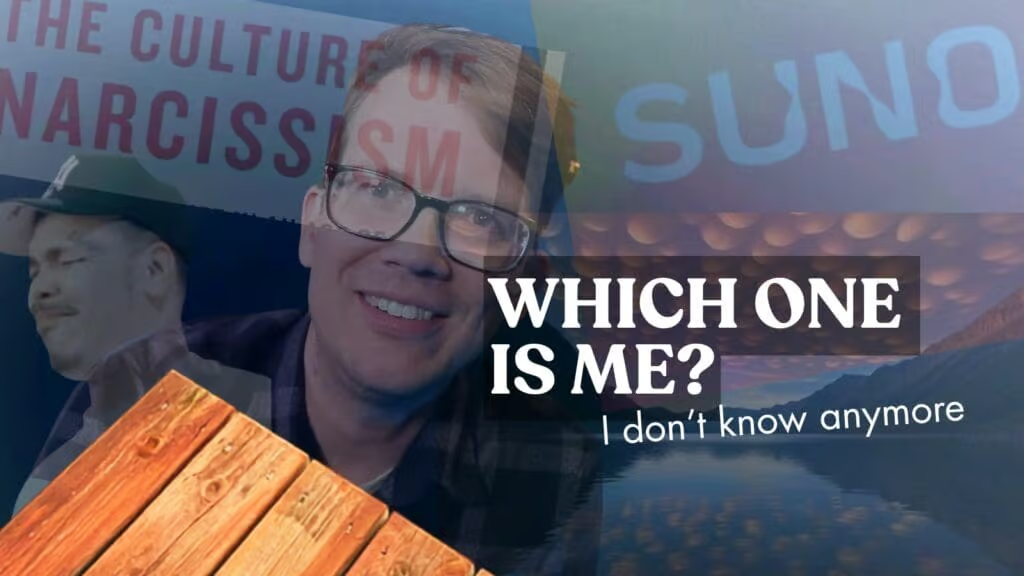
What do people who believe they are writing songs when they use Suno AI, YouTuber Hank Green, and Narcissus from Greek mythology all have in common?
Quite a lot, it turns out. And they can help us recognise a form of stuckness that’s becoming increasingly common as people’s relationship with generative AI begins to blur the boundary between ourselves and the technologies we use, making it more difficult to know where the human ends and the machine begins.
Getting Stuck in the Digital Image
Our relationship with technology and, in particular, large language models (LLMs) like ChatGPT and Suno poses a really interesting existential dilemma.
I’ve been fascinated to see how these are often sold as tools to overcome stuckness. While at the same time, they create a whole different form of stuckness when we become attached to them.
The demise of Narcissus came through an obsession with his own reflection. Perhaps the price of looking away from his reflection brought its own kind of departure and death. Maybe the image had become more real, perfect, and desirable than the human staring at it.
In this episode of The Gentle Rebel Podcast, we consider how the reflection of ourselves in the machines we use can bend us out of shape and leave us uncertain of who we are and what we’re capable of.
What Does It Mean to Write a Song?
Fil Henley, AKA Wings of Pegasus, asked this simple question in a recent video. He analysed an advert from the AI music generation platform Suno, which features producers and songwriters using it to make songs.
Fil says, “If you don’t know what the song is going to sound like before you hear it, then you haven’t written the song.”
Platforms like Suno act like fruit machines. The output is based more on luck than judgement.
What makes them compelling and perhaps even addictive, is that the result is impossible for us to predict. It’s a surprise each time that feels exciting to reveal. And it can turn any old crap into something you might hear on the radio. As we see in the video.
More Than a Tool
This is what makes these services different from tools.
A tool reliably enables us to carry out a task without doing everything and more autonomously. So when the producer says that Suno is showing him stuff he never would have thought about, he is revealing the blurred boundary between us and these machines. It is more than a tool for songwriting. It’s generating the song itself.
Suno isn’t like a digital audio workstation (a tool), where a songwriter records, edits, and produces music they have written and performed. It goes further, making many of the creative decisions that normally require time, judgement, and consideration throughout the songwriting process. In other words, the user doesn’t need the skill required to produce the result.
Whose Ideas Are They?
So if YOU didn’t think of them, whose ideas are they? And if it’s outputting stuff based on something you haven’t thought of, what’s the point in you being there at all?
The song is found in the mirror as generative AI reflects back an image of a reality that doesn’t exist above the surface.
Creative Block as a Rite of Passage
In reality, human creativity emerges through the energy generated by those moments of friction, uncertainty, and obstacle.
By intervening early with generative AI before we have taken the opportunity to grapple with a block, we deprive ourselves of that bittersweet joy of finding something that comes to life THROUGH US.
Instead, a service like Suno short-circuits the block. It presents fully formed solutions that we “never would have thought about”.
Perhaps, we would have thought of something much better and more “us” if we had been patient and given ourselves time to grapple with the block.
The Allure of The Mirror
When you listen to these outputs, there is a professional sheen to them that feels sharp. It sounds just like stuff you hear on the radio. But it sounds like stuff you hear on the radio. There is a sameness to it. An increasingly homogenous stasis.
Maybe this technology is attractive precisely because it DOESN’T sound like us. It’s familiar enough for us to to glimpse ourselves. But we look different. It cleans up the parts we might cringe at and be afraid of revealing. Those bits that feel messy, broken, chaotic, and weird.
We don’t argue with the machine that makes us sound like something you’d hear on the radio, see on TV, or LinkedIn. Slick, clean, authoritative, clinical, soulless, indistinguishable, unremarkable, dull.
Incidentally, this is a good way to identify the best producers, editors, and coaches to work with. They don’t try to make us sound like them or force us to emulate their processes. Instead, they seek to understand and support us. They are able to help us notice, accept, and amplify those parts that we would try to shrink down and hide when left to our own devices.
The machine holds a mirror with some perfected image that we believe is us, but is stripped of blemishes, stains, and imperfections. But rather than being the Platonic ideal version of us, it’s more like an aggregate approximation of who everyone else is in the land of mediocre homogeneity. We arrive in this territory when we sand off our edges and lose our spark.
The Culture of Narcissism
In his 1979 book The Culture of Narcissism, Christopher Lasch offers a fresh way of thinking about the myth of Narcissus. We tend to think that Narcissus died because he fell in love with his own reflection and couldn’t look away, so was unable to do anything other than stare obsessively at himself in the water.
Lasch adds another layer, depicting cultural narcissism emerging as the image of the human in the water becomes more important than the human it reflects.
Telling Us Apart
YouTuber Hank Green recently revealed that he had become over-reliant on ChatGPT after viewers pointed out something in a video that felt off to them.
When viewed in context, the clip actually makes more sense than the reactionary commentary suggested. But while he said he didn’t accidentally read something from ChatGPT left in the script, Green didn’t dismiss the criticism. Instead, he agreed, “I think what people have said in this thread about me diluting myself is spot on”.
Diluting oneself through the use of technology indicates how a separation between the image and the self can get blurred.
This is perhaps why those using Suno to make songs believe they themselves are writing songs.
It’s not necessarily a deliberate deception being perpetrated by people pretending to know more than they do or pretending they’ve done things they haven’t. There is a real belief being seeded and nurtured that means people genuinely struggle to distinguish between themselves and the output generated by these technologies.
The Gift of Getting Stuck
There is a gift in getting stuck along the way during the creative process. It invites us to be resourceful problem solvers. It builds character and reveals more about who we are as we experiment, test, and try things without guaranteed results. Imperfectly. Clumsily.
Grappling with creative friction gives opportunities to deepen our confidence and grow our experiences of being okay after failing. These tools are sold to us as ways to avoid that friction. But in so doing, we avoid strengthening the tension wood of creativity altogether, grown in a dance with the rhythm of life’s winds and storms.
It Takes a Village (of Humans)
In this Sunotopia, depicted through their advert, we see many people gathered in the studio. Yet, the future reality that will come through the success of these platforms appears to be very different.
The technology is moving us away from others so we don’t need a producer, an engineer, or other musicians to work with. All we need is Suno because Suno doesn’t get blocked. It will work with whatever crap you feed it. And it will turn any old noise into the kind of song you might hear on the radio.
Happiness is Only Real When…
Christopher McCandless’s diary concluded that “happiness is only real when shared”. An observation made under tragic circumstances.
I think there is a lot of truth in this. I’ve found many times that even the happiest experiences I’ve had on my own feel more complete when they are witnessed through sharing a story with someone else.
When we’re feeling the pressure to conform to the schedule of our unrelenting world, we need the courage to give it time. To give OURSELVES and ONE ANOTHER time.
Maybe our intuition and imagination will start to show us stuff an LLM never would have thought of…
It is rebellious to release ourselves from the pressure to rush and force output for the sake of it. Technologies like Suno and ChatGPT can become an attractive crutch when they are sold as ways to keep going amidst the limitless demands of a productivity-obsessed world. But they gradually erode confidence in our own creative capacity.
We would do well to remember, “it is no measure of health to be well adjusted to a profoundly sick society”.
This is where we become unstuck (in the best possible way).