
Hi! I'm Andy Mort, and I created The Haven in 2014 as a place for highly sensitive people, introverts and other 'gentle rebels' to explore different ways of understanding themselves and engaging with the world.
Here are a few things you might like to know before we start...
- I'm a songwriter, and for many years I made music under the name Atlum Schema.
- I'm currently producing an album called Home is No(w)here.
- I graduated from the University of Southampton in 2008 with a 2:1 (BSocSci) in Politics and International Relations.
- I worked as an undertaker for six years, from 2015 to 2021.
- In 2021, I completed my first coaching diploma, which enabled me to start my creative coaching practice.
- I host The Gentle Rebel Podcast, where I explore the intersection of sensitivity, creativity, and how culture shapes who we are and how we feel.
- I write a regular newsletter called Notes From a Slow Coach
Where did The Haven come from?
I should briefly mention what this Haven isn't. It is not an AI Bible Chat App.
"That's a weird thing to write", I hear you say. "Why would I think it was one of those?" Well, funny you should ask...
I'm writing this because I've lost count of the emails I've received from angry people wanting to cancel their subscription to an AI Bible Chat app. So, in case you're reading this thinking it is that, it is not. I repeat, this is NOT that. But you're still very welcome to join us!
...OK, So Where Did THIS Haven Come From?
I started building The Haven from scratch. I accidentally stumbled into the role of web designer after developing my first WordPress blog in 2009. The community grew organically from there, alongside my personal interest in understanding my relationship with introversion and high sensitivity. Along the way, I found others who also wanted to explore creative ways to apply our awareness of the trait in everyday life.
Growing up, I experienced things differently from other people. I noticed unusual details and spent a lot of time in proverbial rabbit holes, thinking deeply about things others didn't give a second thought to. And I got irritated by sensory experiences that no one else seemed bothered by, such as itchy jumpers, sudden loud noises, and fluorescent strip lights.
Making Sense of Introversion and High Sensitivity
In 2009, I came across an article by Carl King titled 10 Myths About Introverts. It was definitely an 'aha!' moment when I recognised myself in familiar descriptions I'd never put into words, or had assumed were natural and normal for many people.
I then read Marti Olsen Laney's book The Introvert Advantage, which Carl King had drawn inspiration from. She mentioned high sensitivity, which I had ignored but I eventually discovered Elaine Aron's book The Highly Sensitive Person in 2011.
I think I initially overlooked the phrase highly sensitive because it didn't resonate with me. It made me think of being highly strung or high maintenance, which didn't fit. In fact, when people regularly called me sensitive growing up, the word tended to lean more towards depth than height. I was fortunate not to hear it as an insult or a demand to be different, though I definitely wished I was at times.
The more I read, the more things fell into place. I recognised the depth of my processing, my sensitivity to sensory detail, how I absorbed experiences, and my need for more time to recover after periods of stimulation. I began to understand some of the things I'd previously regarded as personal quirks, shortcomings, or inexplicable contradictions.
The Double-Edged Sword of a Sensitive Drummer
As a child, I was obsessed with the drums. However, I also found loud noises pretty unbearable. Yeah, I know!
You'd find me hiding with the pets on Bonfire Night and during thunderstorms. I hated going to the theatre because there was always a chance of sudden bangs. And there's even a photograph of me at around five years old, standing by my cousin's drum kit. One hand holds a stick and hits the drums, while the other covers my ear in response.
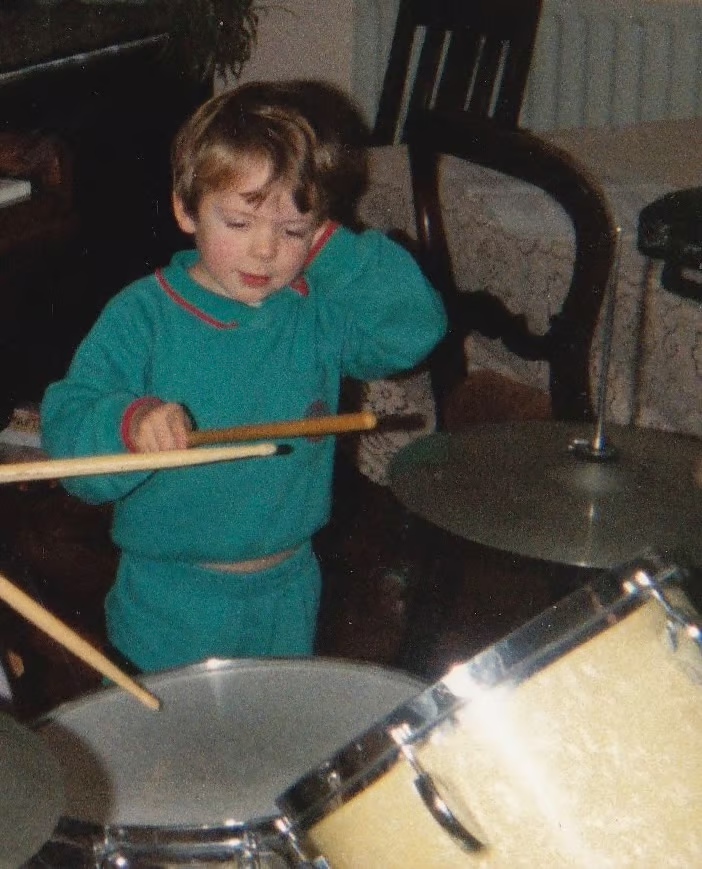
This image seems to capture a natural contradiction at the heart of sensitivity for many of us. We might be drawn to something that is equally beautiful and exhausting, or even terrifying (yes, I also love a classic horror movie... and don't get me started on Twin Peaks!)
Changing The Story Around Sensitivity
At school, I received criticism for not putting my hand up enough in class. It became an annual target, a regular source of disappointment for them.
But when I was studying English Literature at A-Level, I felt something shift in the default story about contributing in class. I had been led to believe it was shyness that held me back. But I realised it was actually the environment. My A-Level English class had eight people. We were reading interesting books, and I often had ideas I wanted to share. It also felt safe not to contribute if I had nothing to say. I got the highest marks in the class.
The more I've researched environmental sensitivity and shared stories with other highly sensitive people, the more I can see my younger self naturally figuring this out. One Christmas, I got decorating supplies and a three-way ceiling light, then treated myself to a dimmer switch and a Chet Baker album to create the ideal ambience.
I didn't know anything about sensitivity or environmental preferences then, let alone 'differential susceptibility'. I just knew what worked for me and sought ways to spend more time in those rhythms and spaces. Sometimes I felt self-conscious because some of these preferences were quite unusual in my immediate environment. So was my fascination with fragrances. We weren't traditionally an Eau de Parfum family. But I remember being completely taken by aromas, to the point that I once ran after someone to ask him about his scent. No regrets!
A Lens For Self-Awareness
Discovering high sensitivity gave me a lens through which I could understand many of these experiences. As I processed my life through writing, it was fascinating to see how some of the stories about formative experiences changed.
I began to consider why a situation could be absorbing, boring, or exhausting, based on tiny differences. And why I could do something perfectly in practice when no one was watching, but then become shaky and confused as soon as I felt someone's eyes on me.
When I played gigs, I'd noticed that my between-song banter (B.S.B.) could vary widely. Sometimes I was chatty, funny and relaxed. At other times, I could barely string a sentence together.
My B.S. Barometer gave me a way to notice the impact of environmental factors such as my familiarity with the venue, the lighting, the temperature, the audience, whether people were paying attention, and who I was with.
This curiosity and awareness grew organically, even without a specific language for understanding what was happening at the level of the nervous system. And as I've worked with sensitive people, I've noticed how this kind of intuitive awareness can develop over time and with space.
We are often natural dot connectors, able to observe patterns, notice how things fit together, and tweak them to help us manage better.
It Just Sort of Happens
In the summer of 2026, I had the opportunity to reflect on the role of creativity in my relationship with sensitivity when I was invited to share my story at the HSP Tribe Gathering in Oulu, Finland.
The film became an audiovisual collage of stories from throughout my life. It focused on how songwriting and music-making helped me make sense of myself, my experiences and the world.
The phrase 'it just sort of happens' emerged early on as I brainstormed ideas. I find myself saying it a lot in life when I'm asked how I ended up on the paths I've taken. I know lots of sensitive people who share this. Especially those of us who have followed less conventional avenues in life.
Creativity and Sensitivity
I believe creativity is especially important for nurturing our relationship with our innate sensitivity. When we absorb messages from the cultures we swim in, we can become disconnected from these natural aspects of ourselves.
I know some people struggle with the idea that they are creative. I love helping them soften this resistance over time, discovering what happens when they give themselves room to explore and enjoy the wonderful fruits waiting to be imagined, realised, and unleashed back into the world.
My personal explorations have always happened alongside others. The Haven has been a place where that can just sort of happen. Through ongoing projects like our community zine, Coming To Our Senses, I deliberately protect space that allows us to explore without pressure or expectation (we can't know what will happen), but instead with curiosity and openness (we can be open to whatever might happen).
I always wanted this space to be somewhere we can share experiences, experiment creatively and learn from one another. It's been this way since I launched its formative version on my then blog, Sheep Dressed Like Wolves, in 2014.
A special mention, too, for Tuula Ahde. She has been with me on this journey from early on. She has become a dear friend over the years, helping shape and care for the community. Tuula brings her special flavour of playful openness to our gatherings, along with a deep well of wisdom about sensitivity from her project, Erityisherkän Elämää (Highly Sensitive Living), a resource website on sensory processing sensitivity linked with the Finnish HSP Association.
You'll find Tuula in and around the village, stirring pots, and hanging out in our Zoom gatherings.
My Community Pledge
We're an independent, member-supported community. My vision has never been to grow beyond what we can sustain in terms of our identity and spirit. I love providing a space where people can feel at home and find others they belong with.
Over the past year or two, hosting costs have risen considerably (hasn't everything!), and I've felt the squeeze of keeping the lights on in The Haven. I'm committed to keeping the community accessible to everyone and free from external advertising. Did I mention I have what can only be described as infuriatingly strong principles at times? Yeah. Well, that's the case here. No advertising, no algorithms, and no hidden hooks.
A Full Membership gives you access to live gatherings, Pick The Lock Courses and Rabbit Hole podcast episodes. It also helps cover running costs and enables me to keep The Courtyard accessible to those who want to stay connected.
If you'd like to support the work but can't commit to a Full Membership, you can make a one-off donation through PayPal.
Learn more about working one-to-one with me in The Fireside.