Don’t Mistake Their Story for Yours

Other Platforms Apple Podcasts | Spotify | RSS | More Destinations
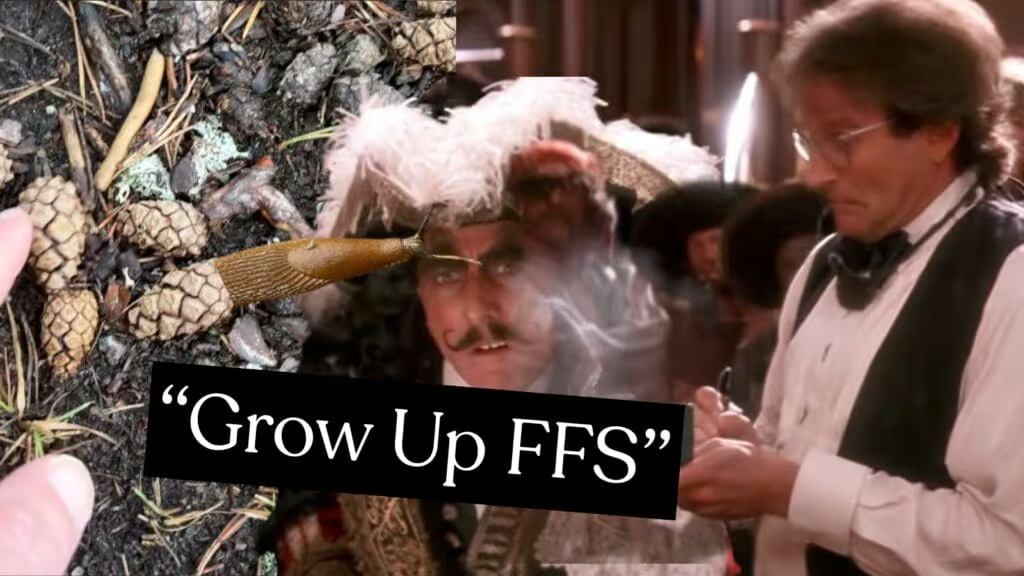
The movie Hook begins with the premise that Peter Pan has been away from Neverland for so long that he has forgotten who he is. He is all grown up, with two children and a high-flying legal job that leaves him little time or patience for them.
When Captain Hook (Peter’s arch-nemesis, whom he now has no memory of) kidnaps his kids, he quickly learns that his attempts to use the logic of his reality to buy them back or to threaten legal action aren’t going to fly here (pun intended). Instead, he needs to do the opposite of ‘grow up’ and rediscover his imagination and ability to play if he is going to survive and accomplish his objective.
This kind of Adult Fog can creep in, obscuring our view of something that’s still there.
I describe this as Adult Fog in The Return To Serenity Island. I’m not imagining something huge descending on us that suddenly stops us from being ourselves. Fog can arrive with a subtle creep. We might not notice the visibility getting worse until we look up and try to see the path ahead.
The path hasn’t disappeared, but our ability to see it has become clouded by other people’s expectations, judgements, and assumptions.
Being Told To Grow Up
Last week, I was on the clifftop, saying my goodbyes to one of my favourite spots overlooking the Baltic Sea in Espoo, after a month in Finland. As I did so, I happened upon something that inspired me to play…
A nest full of abandoned eggs.
Well, technically they were small pine and/or spruce cones. But that’s not what my imagination and I decided to believe.
And so I made a silly video.
After an uber-quick editing job, I posted it online and got in the sauna.
Comments began to arrive. The first one said “they are acorns, not an egg”, which was a slightly strange yet potentially endearing attempt at correcting the details of a joke that hadn’t landed.
But the next two comments really caught my attention. One said, “Grow Up FFS”, and the other said “grown man 😂😂”.
I replied to the comment “grown man” with “I was told it was a Spanish slug”, innocently (playfully) assuming he was referring to the slug. It turns out these “killer” slugs are an invasive species that can harm the native ecosystem. He dismissed this as ragebait, refusing to believe a slug could have made it all the way from Spain to Finland. I’m pretty sure he was serious, too.
His comment was a helpful reminder that growing up doesn’t necessarily equate to knowing better.
Then another comment arrived.
“They are not eggs,” it began.
Oh, here we go again, I thought.
“Anyone can see, they are turds from a walrus. Look up in the trees, and you should see it unless it has flown away.”
I breathed a sigh of relief and smiled. Especially because this looked like a mature, fully grown adult man. And he had come to play. He got it.
People Can Make or Break Our Spirit
It amazes me how much of an impact we can have on other people, including strangers online. It made me think about the power of words and the stories we can create from them without realising. Words can give us wings to fly and explore, and they can give us great weight that brings us down to earth with a great thud.
My natural childlike spirit tends to express itself through silliness and absurdity. When that element of me can emerge, I know I feel safe, which is an important part of this equation.
When I got back to the apartment, I knew I could share what I’d made with Tuula (with whom I was staying), and she’d get it, even if she was confused about what I was banging on about.
Childlike Spirit
Our childlike spirit looks different for each of us. Maybe it’s collecting things, getting absorbed in researching obscure subjects, role-playing, historical re-enactment, making things, nurturing something and watching it change, or getting excited about stuff you are into and looking forward to.
It’s not about being silly or even about “play” in the conventional sense. It’s about having the freedom to engage with the world in a way that feels naturally ours.
And I think the people around us can make a huge difference to whether that part of us gets to emerge. When we feel safe from judgement, ridicule or criticism, we have more freedom to explore it. But when those things are present, the Adult Fog can descend before we’ve even given ourselves a chance.
“That’s stupid.”
“That’s not realistic.”
“We don’t do things like that here.”
“That’s childish.”
“That’s selfish.”
“You’re showing off.”
“That’s unwise.”
“You should know better by now.”
And there’s an interesting link to research showing that when humans lose their bearings, we tend to walk in circles rather than in a straight line. When we can’t see landmarks, natural reference points, or otherwise establish where we are, we can end up returning to where we started.
Perhaps something similar happens when the Adult Fog descends, and these stories obscure the landmarks we use to orient ourselves.
As a result, we might keep moving and try to gather more information, but without our personal bearings, we can burn a lot of energy believing we’re making progress only to find ourselves back where we started.
Stuckness and Social Sensitivity
For Highly Sensitive People, these fog-inducing stories can leave us particularly stuck. We’re often highly attuned to the social environment, noticing other people’s reactions and picking up on subtle signals of approval, disapproval, safety and threat. We can internalise words and judgements that were never directed at us.
“Don’t they realise how silly they look?”
“People like that are so selfish.”
“They never think about the impact of their actions on others.”
These judgements can resurface when we are about to do something important to us. What would that person think of me? Silly, selfish, childish, thoughtless. And so we might pull back and avoid doing what could upset others.
And “selfish” can pack a special punch. We might absorb the message that addressing our own needs, pursuing something we find meaningful, or experiencing joy despite the suffering we see in the news is somehow morally suspect.
For many sensitive people I’ve known over the years, thinking of others comes naturally. The trait has care, connection, and community baked into it. But things can get foggy if we forever de-prioritise our own needs.
What does YOUR childlike spirit look like?
When it’s unclouded by Adult Fog, how do you come out to play?
When do you feel most like yourself?
If you’d like to explore what might be getting in the way of finding your own bearings, I’m going to be exploring more of this over the coming weeks. Sign up below, and I’ll keep you posted.