The Strangest Secret

Other Platforms Apple Podcasts | Spotify | RSS | More Destinations
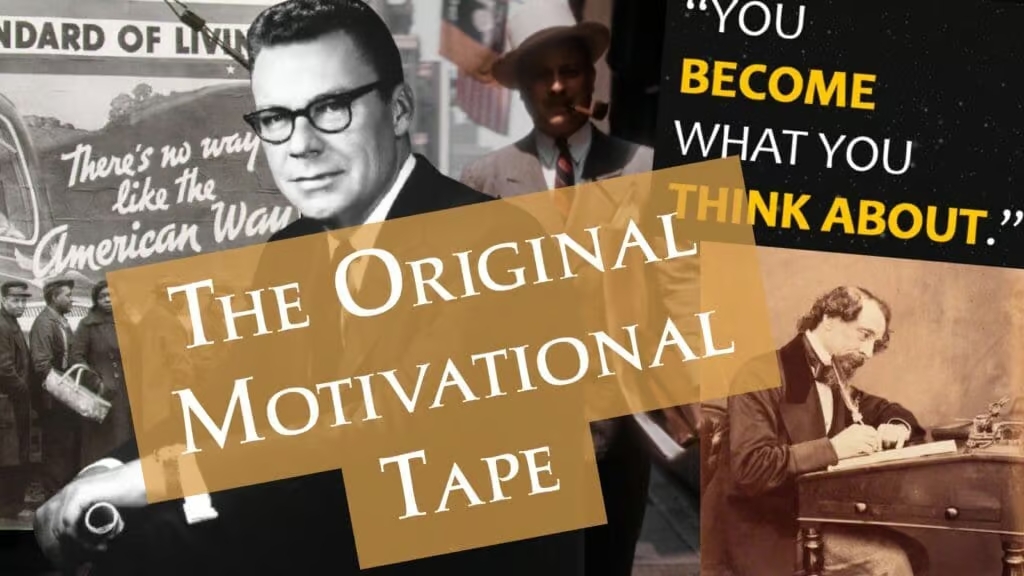
The Strangest Secret was released in 1956. Earl Nightingale’s 35-minute, six-and-a-half-thousand-word recording was one of the earliest motivational tapes. It sold more than a million copies and became the first spoken-word recording to achieve Gold Record status.
The recording was released during a period of post-war economic expansion in the United States. Consumer culture was booming, and suburban home ownership was rising. The promise of upward mobility felt tangible for a growing American middle class encouraged to live a story about abundance, opportunity, and individual advancement.
In this episode of The Gentle Rebel Podcast, I look at some of the ideas and assumptions running through The Strangest Secret, and how they echo themes that have become deeply embedded in self-help culture over the past century.
What interests me is less whether Nightingale’s advice works than the story he tells about success, failure, responsibility, and human potential. It’s a format followed by generations of motivational speakers, coaches, entrepreneurs, and personal development enthusiasts. It continues to influence how many of us think about ourselves and the world today.
I heard about The Strangest Secret through a video by Sean Munger titled The Tools Cult: History of the Amway Motivational Tape Scam. My attention was caught by a reference to Napoleon Hill, who inspired Nightingale when he read Think and Grow Rich in 1948. That book, as well as Nightingale’s tape, became important resources on the Amway reading list.
Nightingale’s Definition of Success
“When we say about 5% achieve success, we have to define success, and here’s the definition. Success is the progressive realization of a worthy ideal.”
This is a reasonable concept. To act in the service of bringing a worthy ideal into being provides a flexible definition that can be applied in many ways.
Nightingale says he believes that success is a life lived with a specific sense of purpose and direction. So it’s confusing when he seems to undermine this by viewing success through a financial lens.
He suggests that if you follow 100 men between the ages of 25 and 65, you would witness a desire for success at the start of life, but by the time they’re 65, one will be rich, four will be financially independent, five will still be working, and 54 will be broke.
This underpins his position that only 5% of people are successful.
So which is it? Being financially independent by age 65 or progressively realising a worthy ideal? Those things are not necessarily linked.
An artist, a teacher, a carer, or a community organiser, and anyone who does something despite the lack of guaranteed financial reward. By Nightingale’s own definition, these people may well be successful. They are realising a worthy ideal. Yet his framework shifts from an existential definition of success to an economic one, where in reality, a person can only be deemed successful if they make lots of money.
Self-Help Tropes
Nightingale’s talk conforms with many of the self-help tropes we are becoming familiar with on this journey.
The Secret
“If you understand completely what I’m going to tell you from this moment on, your life will never be the same again. You will suddenly find that good luck just seems to be attracted to you. The things you want just seem to fall in line and from now on you won’t have the problems, the worries, the knowing lump of anxiety that, perhaps, you have experienced before. Doubt, fear, well they’ll be things of the past.”
The idea of a secret runs through the history of self-help. There is always some missing piece, some hidden principle that, once understood and applied, will change everything. The details vary slightly from book to book, but the structure remains remarkably similar. The reader is invited to believe that happiness, peace, prosperity, confidence, healing, or fulfilment are all waiting on the other side of a single insight.
It’s a compelling promise. Nice if true.
Metaphor As Evidence
Self-help authors often lean on metaphors in ways that make them seem like evidence for a position. Nightingale says, “People with goals succeed because they know where they’re going,” and compares successful people to ships sailing towards a predetermined destination.
He then imagines a ship without a captain, crew, or destination and concludes that it will drift aimlessly.
The comparison sounds persuasive until you stop and think about it. A ship is designed for a destination. Human beings are not. Some of the richest experiences in life emerge through experimentation, curiosity, accident, and changing direction. A ship without a crew and a destination isn’t fulfilling its literal purpose and reason for existing (built by humans as a logistical tool). A human is not the same.
There are many reasons people choose not to structure their lives around the pursuit of goals.
“The man who has no goal, who doesn’t know where he is going and whose thoughts must therefore be thoughts of confusion and anxiety and fear and worry, becomes what he thinks about. His life becomes one of frustration, fear, anxiety and worry and if he thinks about nothing, he becomes nothing.”
I would suggest that many successful people function effectively without the kind of goals Nightingale advocates. And people who have focused so obsessively on a single drive that they’ve lost important things like their health, relationships, and meaningful hobbies.
Cherry-Picked Quotes
Like many self-help authors, Nightingale draws on the authority of famous thinkers. One example is his quotation of Marcus Aurelius: “a man’s life is what his thoughts make of it.” I couldn’t find this in any of the translations of Meditations I checked, suggesting it is more likely a paraphrase than a direct quotation.
The same pattern appears in his use of William James. Nightingale focuses on James’s claim that if you wish to be rich, learned, or good, you can become those things.
“If you only care enough for a result, you will almost certainly ascertain it. If you wish to be rich, you will be rich. If you wish to be learned, you will be learned. If you wish to be good, you will good. Only you must then really wish these things and wish them exclusively and not wish at the same time a hundred other compatible things just as strongly.”
To achieve something extraordinary requires excluding countless other possibilities. What happens when wealth becomes the exclusive organising principle of a life? What gets pushed aside? Relationships? Leisure? Health? Community? James seems at least as interested in that question as he is in achievement itself. Nightingale doesn’t acknowledge this.
The Strangest Quote of Them All
Perhaps the most confusing quote he uses is from George Bernard Shaw, who said, “People are always blaming their circumstances for what they are. I don’t believe in circumstances. The people who get on in this world are the people who get up and look for the circumstances they want and if they can’t find them, make them.”
It sounds like Shaw was spouting a self-help slogan. But this sounded strange to me because Shaw was a committed socialist and a leading member of the Fabian Society. He spent much of his life criticising the idea that individuals simply rise or fall according to personal merit. He repeatedly explored how economic and social structures shape people’s lives in his plays. Throughout his work, Shaw explored the relationship between individual agency and the social conditions people inherit.
So where did this quote come from?
It is actually a line spoken by the character Vivie Warren in Mrs Warren’s Profession, not by Shaw directly. As with any playwright, author, or comedian, we need to be careful about treating a character’s words as the artist’s personal philosophy.

The Obligatory Call To Action (and disclaimer)
Like any good self-help talk, Nightingale finishes with a challenge. Write down what you want more than anything else. Carry it with you. Look at it every day. Maintain a positive outlook and give more than you’ve ever given before.
The framework handles failure with a familiar disclaimer. If the method works, it gets the credit. If it doesn’t work, responsibility falls back on the individual. You didn’t believe enough, weren’t committed enough, lost focus, or didn’t give what was required.
This secret is neither particularly strange nor surprising. It is a derivative of Napoleon Hill. In fact, it’s almost identical to what he wrote in Think and Grow Rich.
There is always another level of effort required and another reason success remains just beyond reach. The possibility that the promise itself might be flawed rarely enters the conversation.
My Enduring Question
There is a gap between the question Nightingale starts with and the answer he arrives at.
As a child growing up in poverty, he wanted to understand why some people prospered while others struggled. It’s an interesting question to explore. It opens up the potential to probe into themes of opportunity, power, ownership, luck, and the socio-economic landscape of society itself.
Yet by the end of The Strangest Secret, that complexity has been replaced by a one-dimensional explanation and cure. Inequality is a direct product of our thoughts, goals, and willingness to work in the service of our personal dream.
This move has become so familiar within self-help culture that it can be difficult to notice. Social questions become personal. Structural problems are solved by mindset. Inequality becomes a failure of ambition, and burnout becomes a failure of attitude.
More than seventy years after The Strangest Secret was released, people are still being sold variations of the same promise.
Support My Work
It takes me time to research, produce, and edit these episodes. You can support me by sending a one-off donation or join us in the membership.