The Prosperity Lie of Positive Thinking


Other Platforms Apple Podcasts | Spotify | RSS | More Destinations
How did Norman Vincent Peale’s book, The Power of Positive Thinking, pave the way for the prosperity gospel and the law of attraction that still has its claws in today’s culture? That’s what we explore in this episode of The Gentle Rebel Podcast.
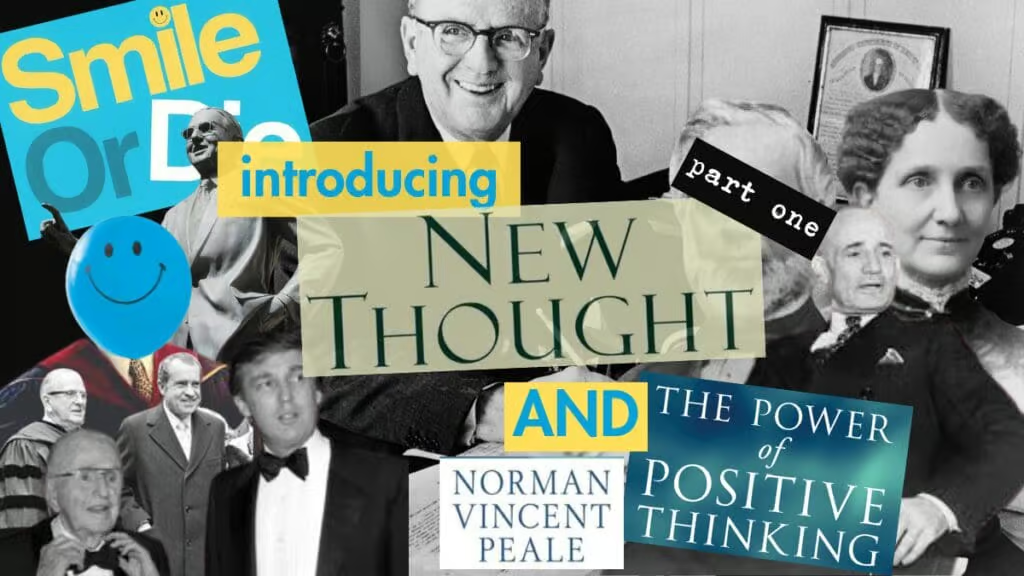
Part One explored Peale’s foundations in the New Thought Movement of the nineteenth century and its theological departure from Puritanical Calvinism.
Part Two linked Peale’s version of Positive Thinking with the corporate culture of the twentieth century. We saw how it provided bonus benefits to companies laying off workers.
In Part Three, we look at links between Positive Thinking and the Prosperity Gospel, and its potential to exploit vulnerable people with promises of great wealth in exchange for willingly giving their money and going into debt because of promises made by those in power over them.
The Prosperity Theology of Positive Thinking
This brings us full circle to the ‘theological’ dimension of Peale’s project. One of the most common complaints in reviews of The Power of Positive Thinking is that it unexpectedly contains so many references to God and the Bible.
But this is the point of it. Peale builds on the New Thought tradition, using Bible verses to support the law of attraction he proposes, driven by a god who “rates you according to the size of your prayers”, and rewards you if you dream big and visualise having already received the objects you desire.
Norman Vincent Peale was a minister who used his position to gain credibility and status in the eyes of his followers. As God’s spokesman, he was taken seriously when he preached. But as we saw in the first part, he was an expert at cherry-picking Bible verses to suit his purposes, stripping them of their narrower and broader theological contexts.
The Formula For Peale’s Law of Attraction
Peale turns basic psychology into cosmic superstition. As we saw in the previous episode, when he took the story of Job and interpreted his words, “What I feared has come upon me and what I dreaded has happened to me”, as meaning Job invited his fate BECAUSE he feared it.
This conforms to Peale’s scientific formula for success (and failure): “Affirm it, visualize it, believe it, and it will actualize itself.”
Whether it’s something we desire or something we fear, it will actualise itself if we think about it. “When you expect the best, you release a magnetic force in your mind which by a law of attraction tends to bring the best to you.”
Of course, we understand that confirmation bias means that when we expect something to be true, we are more likely to find evidence to support it. As such, we might lead ourselves towards outcomes if we believe something has made them more certain.
All Things Are Possible…
Peale tells the story of a faith healer who helps a struggling baseball team on a losing streak. They were riddled with doubt and didn’t believe they could win. One day, the coach asked for the team’s bats and then disappeared with them. When he returned, he excitedly told the players that the preacher had blessed the bats. They now contained a power that could not be overcome. “The players were astounded and delighted,” Peale reports. “The next day they overwhelmed Dallas, getting 37 base hits and 20 runs.”
“All things are possible to him that believeth”, Peale affirms, implying that God rewards faith. This raises the question: Is God needed in this equation, or is it just a belief in God held by those seeking a change of fortune?
And if this is the case, how is this exploited?
Televangelism and The Allure of Prosperity
In Smile or Die, Barbara Ehrenreich writes about the televangelist and leader of a Texas megachurch, Joel Osteen. She cites a passage from one of his books in which he describes his initial resistance to his wife’s pleas to upgrade to a bigger house.
Eventually, he was talked into agreeing. He said it was only because Victoria had used words of faith to persuade him to broaden his vision. This meant God showed him how much more he had in store for him. He presented it as self-sacrifice and obedience to God, rather than an act of indulgence.
This is an application of Peale’s core message. It uses God as a justification for desire. The appearance of material wealth and success is presented as confirmation that you are doing God’s work. It is a reward for your faith. This extraction ecosystem encourages followers to give their resources to trusted spokespeople for God. The explicit promise is that doing so will trigger a transactional response from God.
The God Complex of The Rich and Powerful
Ehrenreich points to the God complex present in the executive mindset. Steve Eisman calls it ‘hedge fund disease’, which he suggests should be included in the DSM-5. It is conspicuous in the symptoms of megalomania, narcissism, and solipsism. It boils down to the more money you have, the more right you feel about everything. And “to think something is to make it happen.” Because of the power and wealth you have access to wield, in a sense, “You’re God”.
We see this at play today, with the rich and powerful indulging in projects well outside their areas of expertise. They try to dictate tastes, behaviours, and trends, so they might exploit their followers’ trust. And, much like prosperity-gospel preachers, they persuade people to follow their advice by promising great future returns. We’ve seen this in NFT scams, pump-and-dump crypto coins, and AI investment advice. Some of these figures are delusional. While others are cold and calculating in their efforts to exploit and extract wealth from those who trust them.
Breaking The Spell
The Power of Positive Thinking reinforces a delusional superstition. Fear itself becomes something to fear, avoid, or eradicate, rather than to listen to and respond to appropriately.
It is also delusively aspirational, portraying capitalism as a system that rewards all who believe in it while ignoring the inherent logic of a system that functions on inequality. Peale follows in Napoleon Hill’s footsteps, believing that poverty and suffering are simply the result of poor thinking and insufficient passion and desire for wealth.
This episode is part of the project I’m working on, which examines notable books and figures in the self-help industry. It began with a desire to slow down and examine my own critical thinking on this topic.
Get in Touch
What else should I read as part of this project? Drop me a message and let me know!