
How I Use One-Page Mini-Zines To Generate Ideas Quickly


Other Platforms Apple Podcasts | Spotify | RSS | More Destinations
Do you want to generate ideas quickly, without overthinking, without requiring perfection, and without using AI tools?
One-page mini-zines are great for brainstorming and exploring things with both speed and depth.
In this post, I want to show you how I use this medium not only to structure our Haven zine, but also to develop its topics and prompts. Mini-zines can be a great tool to carry in your back pocket (literally!) for processing, planning, and expressing yourself in different contexts
It often helps me when my mind is drawing a blank, and I want a low-stakes way to expand how I think about parts of life that feel stuck and in need of a shake-up.
At the end, we will do a quick, easy exercise together to get some creative juices flowing without using much brainpower, if you’re up for it.
What is a mini-zine?
If you’ve never seen one before, a mini-zine is folded and cut to form a booklet you can hold in the palm of your hand. My favourite way to do it has eight panels that become pages. It is also reversible, so you can use sixteen pages from a single sheet of paper.


The nature of zine-making is that there are no rules. As long as you have something to write with, you can turn a piece of paper into a mini-zine. No extra tech or tools required.
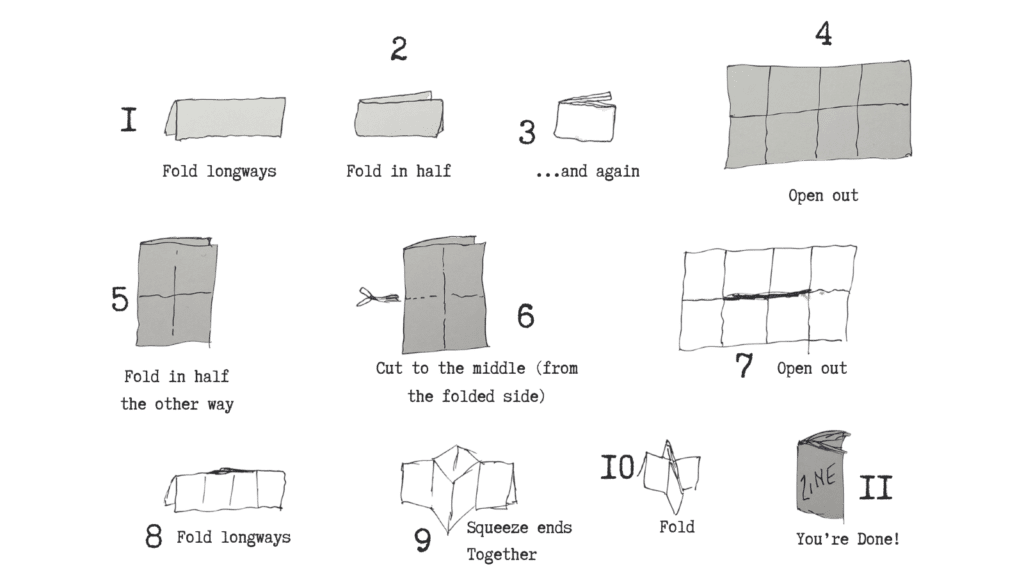
Here is the basic folding method I use
Folding a One-Page Mini-Zine
- Fold the paper in half lengthways.
- Fold that in half.
- Fold it in half again.
- Unfold it all and fold it like a booklet.
- Cut the fold down the middle halfway to the intersection of the fold across.
- Open it out and squeeze it to form a diamond.
- Push it together and flatten.
- Fold again, and you have a booklet you can flick through.
When I use mini-zines to generate ideas, I keep them in this booklet format and treat each panel as a separate page. As you will see if I number each page, this does not necessarily put the pages in the most obvious places. You get used to it after a while.


This format has been great for this collaborative community project in The Haven because it gives us limits. We set a six-week window for development and production, and we have sixteen pages to fill, including the cover and back. We use a simple prompt and let our imaginations take hold.
Why Mini-Zines Work For Generating Quick Ideas
For me, the core element that makes this work so well is its limits.
One of my biggest obstacles to ideas is the blank page. The paradox of freedom is that when we feel too free, we often end up searching for rules anyway or staring at a blank page forever. Eight or sixteen panels are perfect numbers for setting limits on idea generation. Not enough to be overwhelmed, but not too few to feel pressured by the need to be perfect.
When we are aware of the limit, we are free to stop once we reach it. Our only task is to keep generating ideas until we reach the number. Quantity matters more than quality at this stage. We know we can refine and iterate later.
A quick exercise to try (10 Minutes)
We can do a simple exercise with a blank mini-zine. Go through and number each page like I showed earlier.
Set a timer for one minute. On each panel, write down as many things as you associate with the number as you can. Don’t edit, self-censor, or overthink it. Let your intuition lead the way.
Reset the timer and do the same for each numbered page.
When you’ve finished, flick through the pages and see what you notice:
- What catches your attention as you go through the pages?
- What were you feeling and thinking while doing this? (Did it feel simple? Were you hesitant or resistant? Did you feel rushed or able to move at your own pace? Were some easier for you than others?)
- What do you feel drawn to explore next as a result of this?
There are five more exercises like this that I will share in future posts. I will break them into three broad categories: brainstorming for quick creative ideas, brainstorming for helpful questions, and brainstorming for fresh options when facing challenges and decisions.
If you fancy joining us to collaborate on a future issue of Coming To Our Senses, The Haven doors are always open.