
The hope kills us…sometimes

There is the kind of hope that sustains and the kind that exhausts.
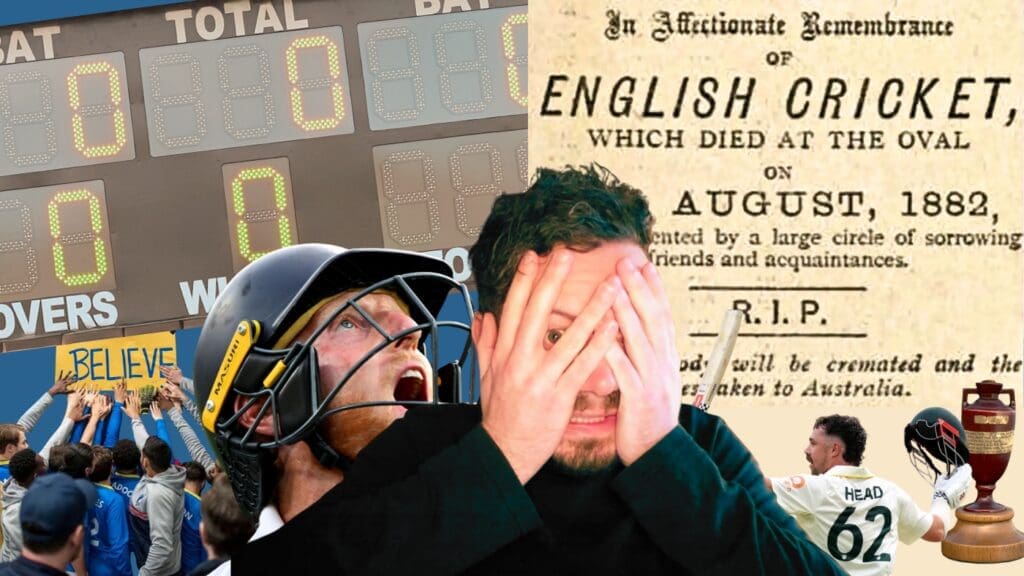
As I write this, we are in the middle of an Ashes cricket series, where every two years, England and Australia compete to retain or reclaim The Ashes, a four-inch (10cm) urn containing what is believed to be the charred remains of a cricket bail (the part that sits atop the stumps on a cricket pitch). It is played over five five-day test matches.
The tradition dates back to 1882, when a mock obituary declared the death of English cricket after Australia’s first win on English soil. It was said that the body would be cremated and the ashes taken to Australia. This apparently prompted the England captain’s vow to bring back those ashes when they next toured Australia. The small urn was presented on the subsequent tour down under, and eventually, the Ashes became the accepted name for the alternating series in which each team hosts the other every four years.
“It’s The Hope That Kills You”
Are you familiar with that expression?
I was listening to Test Match Special (TMS) on BBC radio last week, and ex-Australian fast bowling legend Glenn McGrath was discussing the chaotic nature of England’s performances in the first two matches of the 2025/26 series. The presenters were reading and responding to listeners’ emails. One used the phrase “it’s the hope that kills you” when lamenting England’s poor performance, but keep a sliver of the dream alive.
McGrath said he encountered this phrase for the first time six months ago and didn’t understand it. “Surely, it’s the hope that sustains you,” he protested.
This was perfectly timed because I was thinking about the question, “How do you discern between hope that sustains and hope that exhausts?” for The Haven Journal Circle.
“It’s the hope that kills you” is a familiar saying in the UK. It reflects the traditional stoic, stiff-upper-lip attitude, which suggests, almost superstitiously, that it’s foolish to have high hopes. Better to expect the worst, so you’ll never be disappointed.
However, I believe most people instinctively understand where this phrase originates. It’s the extra blow of disappointment that strikes when we catch a glimpse of optimism. We begin to think, “Maybe, just maybe, this will turn out alright,” only to feel a pang of shame for allowing ourselves to hope, despite the odds.
Is The Hope Exhausting or Sustaining?
In some ways, we might see this “supporter’s hope” as a hope that exhausts. You’ll recognise it if you’re a sports fan, a role in which the only thing within our control is to encourage, cheer, and cross our fingers on the sidelines.
McGrath was perhaps confused about the saying, in part because he was viewing hope from within the dressing room. As long as there’s a chance, hope is not lost. This thought can sustain belief, and that belief can fuel positive action. This is invaluable for the person or people who can do something about it. Hope is active and creative. It can be transformed into change.
Facing Disappointment
It also made me think about disappointment itself and the role it plays in all this. Being a sports fan is one of the few places where we willingly enter a situation we can’t directly influence, at the very real risk of disappointment. Despite our better judgement, we still hope. The rising sense of “maybe, just maybe” whispers in our ear even when history tells us not to. Knowing it will probably fall apart, we show up anyway because sometimes miracles do happen. Maybe this will be one of those some-times.
There’s something strangely beautiful and valuable about the supporter’s hope. Made all the more poignant in its futility. It means nothing, and yet it means everything. The disappointment doesn’t imply we were foolish to hope. It reveals what mattered to us. After the game ends, the feeling (eventually) passes through. We might chunter about it, we might feel a bit flat for a while, but we can otherwise carry on with our day. And the wonderful thing about sport…there’s always next time.
But beyond the sporting context, hope can become exhausting when we are willing, wishing, longing for a person or situation to change. It’s the hope that kills you when those little flickers of light are snuffed out and the same old patterns and business as usual return.
Momentum and Flow
How do you discern between hope that sustains and hope that exhausts?
Responding to this question on Instagram, Liza described maintaining hope as engaging in those things that light her up when she thinks about them. It’s when action occurs without expectation and at the same time becomes the catalyst for the next steps.
This resonates with me as creative flow and the momentum that arises when I let it happen without force or trying to control the process. Sitting on the opposite side of the exhausting hope of passive wishful thinking and the persistent, lurking presence of an energy that keeps us captive. Striving to move forward just to escape the pressure or expectation of the current situation.
The Inside and The Outside
Liza’s description also highlights an important distinction. Sustaining hope exists within the figurative dressing room. It’s what we feel when we are actively engaged in something that matters to us, even in a small way. And we are in a position to affect and change it. It grows through action rather than in wishful passivity, gaining its own momentum.
Exhausting hope, on the other hand, is what we experience outside the dressing room, wishing for something to happen while lacking real influence over the outcome. It emerges in the waiting spaces. If you’ve ever sat by the phone after a job interview, refreshing email or replaying the conversation in your mind, you’ll know the feeling. Once you’ve done everything you can, hope becomes a tiring kind of busywork.
Busywork and Self-Sabotage
We might interpret the silence, imagining reasons for delays, and trying to control things when no further action is possible. This is draining because no matter what we do, we can’t affect the change we want to see. In fact, we risk sabotaging it by meddling, tweaking, or irritating others.
Sustaining hope sits in the opposite corner. It’s the decision to act where action is possible and to release the rest.
McGrath’s line, “It’s the hope that sustains you”, is about knowing the difference between the hope that drains us because there’s nothing more we can do, and the hope that strengthens us because we’re inside the situation, shaping it as we go.
Where do you feel hope draining and sustaining you in life right now?