7 Reasons to Start Drawing

Other Platforms Apple Podcasts | Spotify | RSS | More Destinations
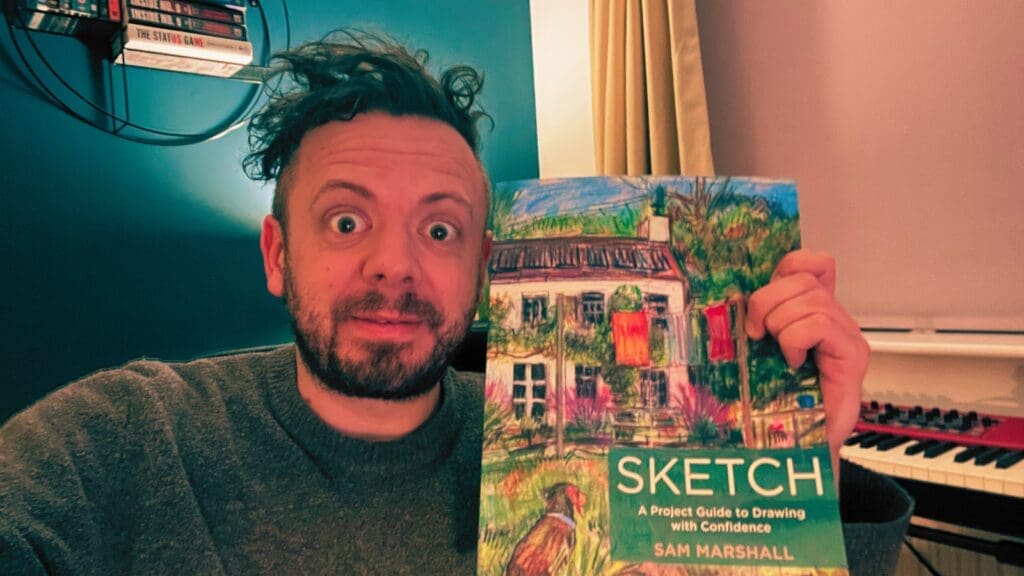
I’m holding something very exciting in my hands. A physical copy of Sam Marshall’s beautiful book, Sketch: A Project Guide to Drawing With Confidence. Sam and I spoke about it a couple of weeks ago.
I want to pause at the beginning because the first chapter, Why Sketch?, is packed with juice. It speaks to how I understand creativity and why it matters, not just personally but collectively. Whether or not you plan to start drawing, this feels like a reminder of why creativity matters at all.
It feels more important than ever to emphasise the role of analogue, tactile, hands-on forms of creative play, which give us something we can’t get in the slightly disavowed relationship with creativity mediated through a screen.
“To make art is to sing with the human voice. To do this you must first learn that the only voice you need is the voice you already have.” – Art & Fear by David Bayles and Ted Orland
This feels like the grounding point. As Sam says, this is not a “how to draw” book. It’s an encouraging project guide that helps you sketch in your own way, connecting with confidence in your own creative voice. The voice you already have.
Sam offers seven compelling reasons to develop a sketching practice. They act as anchors we can return to when resistance shows up.
1. A Space to Call Your Own
Sam describes the sketchbook as:
“Your own private sanctuary. It’s a place for you to express yourself freely, without judgement or criticism.”
In a world shaped by the onlooking gaze, this feels gently rebellious. A space held for yourself. Not for sharing. Not for approval. A place with no rules, as a private breathing space for the creative spirit.
2. A Gentle Way to Explore Your Creativity
All you need is a sketchbook and a pencil. That’s it. A low-stakes beginning that resists the urge to wait for the right materials or conditions.
This is an unfolding practice, not an outcome-driven one. You add things as you go, once you get a feel for what deepens what you’re already doing.
3. A Way to Slow Down and Be More Mindful
Sam writes:
“I draw to calm my busy mind, to slow down, and to connect with my surroundings. I guess you could say that drawing is my meditation.”
This is true of many creative practices. They can’t be rushed or forced.
I remember joking when ChatGPT first launched that I wouldn’t need to journal anymore. Instead, I could just ask it to write an entry and I wouldn’t have to think. This was obviously absurd, yet I later met people doing exactly that.
It shows how productivity thinking has taken over. Doing things only if they serve a measurable purpose. Drawing starts to feel acceptable only if it can be instrumentalised. That framing strips it of its real value.
4. A Way to Help You See More
Sam writes:
“Drawing helps you see. The more you draw, the more you look, and the more your world opens up.”
“When you take the time to draw something, anything, you notice details you might otherwise miss. It helps us see what is there, rather than what we think is there.”
Seeing more is not something you can rush. It’s a by-product of staying long enough. Drawing creates the conditions for noticing.
5. To Lift Your Spirits and Connect to the World
Sam says:
“I feel so connected to the places I’ve drawn; they are special places in my mind, and because I’ve committed them to memory through drawing, I feel I’m able to visit them anytime.”
Drawing embeds you in a place. It’s the difference between depth and skimming. Between “doing” a place and actually tasting it. Creativity changes how you inhabit the world. It moves you from consumption to relationship.
6. To Reconnect With Yourself and Your Goals
Sam writes:
“If you’ve had a rocky road with drawing in the past, if you’ve felt you aren’t creative, then just proving to yourself that you can draw can be incredibly healing.”
Creative hobbies are generative. They can spark confidence, energy, clarity. When we slow down, things start to connect across different areas of life. Breakthroughs and insights appear in their own sweet time.
7. A Tool for Remembering
Sam notes:
“My sketches evoke more memories than any of my photographs do.”
This speaks to the role of the senses in memory. Being somewhere long enough for your internal state to change. Long enough to feel hunger, shifts in light, temperature, mood. Drawing deepens the bond between experience and memory. And when art is involved, even mundane days become memorable.
Time, Fear, and Returning To Simplicity
Sam asks: What’s preventing you from keeping a sketchbook?
Time often comes up, but it’s usually a cover for fear. Fear of messing up, not knowing what to draw, or not matching what’s in your head.
Her suggested mantra:
“There’s nothing to be afraid of. It’s just a pencil and a piece of paper.”
Drawing becomes easier the more it’s woven into daily life. It only feels indulgent because creativity is still framed as a luxury rather than a foundation of wellbeing.
Sam reminds us that we don’t lack time. We lack structure. And even that can be simple. A sketchbook to hand. Small pockets of waiting. Moments that already exist throughout the day.
We need drawing to occur to us as an option. Low stakes. Quick. Easy. Something to return to without thinking.
This is what Sketch does so well. The prompts become instinctive. The friction drops away.
I’m looking forward to taking this book with me to Finland next month. I’ve never kept a consistent drawing habit, only fits and starts. But I’d love for it to become a steady part of my creative life.
Over to You
Do you sketch, or would you like to start? What are your reasons?
Drop me a message. I’d love to hear from you!