
Light and Shadows
Become Visible
Photography is about capturing light: seeing and controlling it. This happens through a mixture of technology and the choices made by the photographer themselves (time of day, angle of view, shutter speed etc.)
Light can reveal or hide things. It can create an atmosphere. But it can't always control or guarantee emotional responses that arise in the viewer.
When we look at photos we pay attention to the light and comment on how beautiful it is. How often have you analysed and commented on the qualities (shades, strength, or shape) of the shadows in an image?
Dare to become visible with your inner light and shadows
We can often be very critical of ourselves. It might be hidden courage, or a particular feature, trait or talent that we have taught ourselves to keep hidden.
Our creativity, joy, compassion, skills, knowledge, and resources, are the light in each of us. We nurture conditions for deep inner growth when we allow the light to be. This is the beauty, authenticity, ability we can see both in ourselves and in others.
This light is our golden shadow.
Don't be afraid of the shadows, listen to what they are telling to you
The brain processes what it interprets as essential, focussing attention on the subject itself, not for example, on the shadows or reflections it creates. But in a photo, these elements can sometimes become the most important and interesting aspect of the picture.
Whether setting up a shot or assessing a final image, the photographer learns to see the whole picture. They take into account all the visible elements and are mindful with how the objects within a frame relate to each other.
Likewise, it is good to make the shadows in your own personality visible to yourself. Shadows refer to those qualities and experiences we can find difficult to accept in ourselves. These are things we might not want to reveal to others. But they are always present in the "picture". Hidden in the shadows are also the aspects of ourselves that others have not accepted. The parts of ourselves that have been laughed at and experiences that have made us feel shame.
There are qualities and certain needs that we have kept hidden in the shadows, in order to protect ourselves from further harm. The decision might have been made at a very young age, to never let anyone see those parts of ourselves again.
There is nothing reprehensible or shameful about the shadows. But it is good to be aware of their existence. Otherwise they can subconsciously steer certain aspects of life in directions we might not want to choose, especially at times of stress.
"Bringing out our own lights and shadows requires courage: we rarely dare to try a new, unknown role or level of self-expression that we do not control. For this reason, the same patterns, experiences, and destinies are always repeated again and again in our lives." - Eevi Minkkinen
Your strengths may hide in the shadows, so now is the time to bring them into the light.
By recognising and getting to know your own shadows, you can become a stronger and calmer version of yourself.
Do you recognise your own stress behaviour style? Do your stories of past hurt and shame lurk in the shadows, and dictate how you now engage with things when you're under pressure?
Creative methods like photography are a great way to do "shadow work" (raising awareness of shadow feelings and behaviours). Not forgetting those hidden golden shadows of yours.
The purpose is not to fix everything in our shadow side, but to become aware of them. It's about learning to recognise their existence so that they do not hold our lives, behaviors, and experiences captive. There is also a "dark" side in humanity, and shadows play an important role.
The journey to self-knowledge needs courage, honesty, and self-compassion.
With the help of shadow work, we can learn to better understand the behaviour of others as well. We will begin to see clues about the world of experience and where emotions are hidden under the covers.
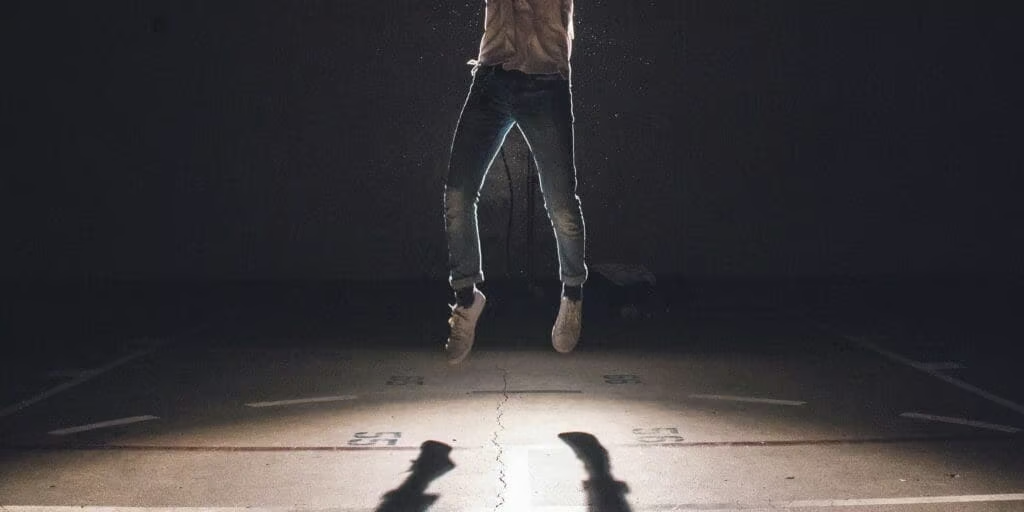
"The possibilities for variation of light are infinite: lighting can be revealing brightness or hidden darkness, it can be arousing or terrifying and everything in between. Because light is strongly connected to the human emotional world, it is in all its diversity a susceptible element to misinterpretations.
I think the interpretation of the messages of light is largely a subjective and learned thing. And if it is found that light is interpreted with emotion, it is also created with emotion."
- Pekka Kallasaari
SENSE AND EMOTIONS
Narrative lighting in photography
"INVISIBILITY and loneliness are related to each other, but they are not the same thing.
Invisibility from one situation to another may be due to the evasive body language adopted as a result of humiliation. One may also be cousious and sensitive to interpreting the expressions and tones of others: I guess that soon I will be rejected and ignored.
One respondent said he was moved when automatic sliding doors in the city open in front of him. Just like in front of anyone. It felt weird."
Hs.fi: Olen kaikille vain ilmaa, I'm just air to all
"BECOMING VISIBLE is always some kind of conscious or unconscious choice: I inevitably share only a part of myself, not quite everything. It doesn't mean I play a role or be something else than me, but that some things are private and sharing them wouldn't even serve anything or anyone.
But then there are situations I can’t control. Moments when I’m not intentionally visible, but still someone notices me. People see me through their own beliefs, expectations, hopes, even fears. In recent days, I have identified a fear in me that I'll be a disappointment. That I am not in all respects what is expected of me.
But if I tried to please everyone, it would mean giving up my own power to others."
- Katri Syvärinen
Shadow behavior patterns or characters, ways we protect our shadows:
- criticism: we can be very critical to ourselves, others and things
- lack of boundaries (towards others or own behavior)
- denying weakness or vulnerability in oneself
- indecision, withdrawal, procrastination
- irritability
- perfectionism
- the need for being in control
- tend to take everything personally
- jealousy
- judgemental mentality, the need to find who is quilty
- envy or competition
- self-praise, a sense of superiority
- manipulation, intrigue
- victim mentality etc.
PROMPTS | Part 2
Let's Be Shadowhunters
Pay attention to shadows. Consider their size, intensity, color and impact on the landscape and space.
Look at your own shadow like a child or a pet who, for the first time, notices their companion - are you going to play with it or does it feel oppressive? Where is it in relation to you? How does it move?
1a. Shoot your own shadow OR the shadow of some interesting and symbolic object so that the shadow is clearly an essential part of the image and its composition.
1b. Give a name to the shadow
- What does the shadow represent? (feeling, mood, pattern of behavior, memory/history, etc)
- What intuitively comes to your mind?
- When does the shadow tend to appear in your life? What shape, size, and strength is it?
- What good could that shadow represent?
- Now that the shadow is visible, can you find something humorous in it?
- Which one appears stronger in the picture...the shadow or the subject? The subject can sometimes even be invisible, outside the photo, where only the shadow is visible to the viewer.
Upload your photos to the Photoyoga WhatsApp Group
Mark your photos: SHADOW
"If you have no shadows, then you're not standing in the light."
Lady Gaga
©2017-2026 by Fotojoogaa mielelle Photoyoga For The Mind
Copying and unauthorised use of images and site content are strictly prohibited. This site and all material are for participants' personal use only.
Photoyoga on Social Media
Facebook: Fotojooga on Facebook | Instagram: @fotojooga
Email: fotojooga (a) gmail.com