
How Positive Thinking Became a Religion

The Power of Positive Thinking promised liberation from feelings of inferiority and self-doubt. But did it simply deliver us a new set of demands and anxieties to adhere to?
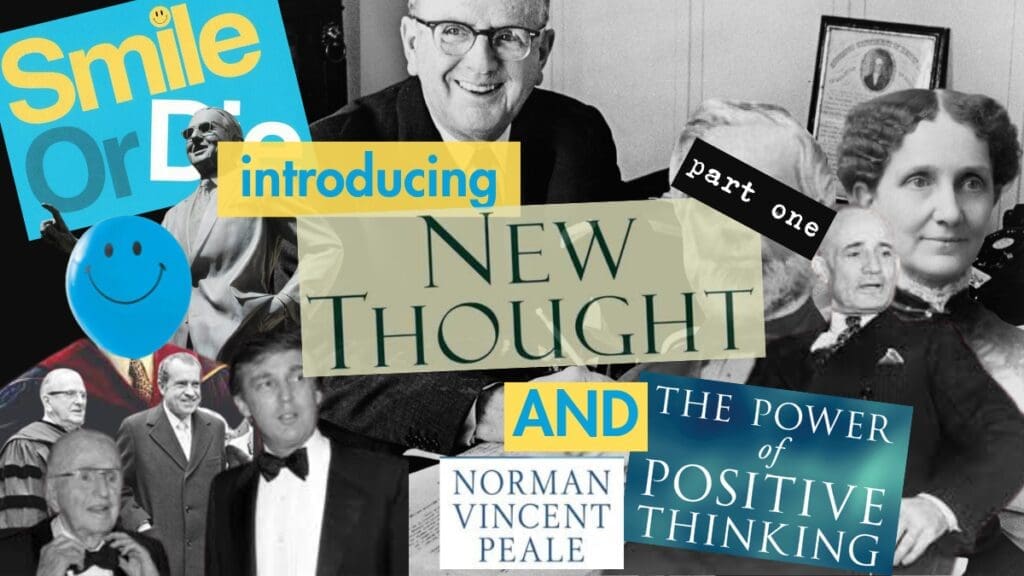
We often consider positive thinking as a beneficial mindset that enhances performance in sports and other activities. However, it is more than just a description of a possible behaviour. It is also the title of a 1952 book by Norman Vincent Peale. The Power of Positive Thinking builds on the New Thought movement that emerged in the 1800s. It had been a response to the effects of Calvinistic Christianity on the health and well-being of Puritanical America.
Donald Trump attended Peale’s Marble Collegiate Church as a child. He admired Peale’s robust, businesslike approach to Christianity. The engaging sermons lent a sense of cosmic legitimacy to his family’s brand of hyper-individualistic capitalism.
The Next Stop on the Magical Thinking Tour
This episode of The Gentle Rebel Podcast is part of my meandering journey exploring the history of self-help. The Power of Positive Thinking is a valuable piece of the larger puzzle. It provides a clear context for the foundational role of American Christianity in a multi-billion-dollar industry.
The book faced criticism when it was published. Leaders in the Methodist church described Peale’s followers as a cult that had ceased worshipping Christ and started worshipping success. Reinhold Niebuhr, author of the Serenity Prayer, said Peale’s teachings “corrupted” the Christian gospel. He argued Peale’s message was harmful to people. On the one hand, making them feel good, while on the other hand, stopping them from seeing and confronting the real issues at the heart of their struggles.
In this episode, I refer to Barbara Ehrenreich’s 2009 book, Brightsided. Ehrenreich did an excellent job contextualising the book and outlining the history of Positive Thinking and its foundations in New Thought.
The Calvinist Inheritance
Positive thinking emerged from New Thought. This movement was in part a reaction to the dominance of Puritanical Calvinism in the formation of the United States. Predestination meant followers were subjected to a socially enforced depression. This centred on the limited number of seats in Heaven, which have already been allocated to those God has elected.
This mindset could be said to have helped the Puritans survive the harsh conditions of the New World. At the same time, they struggled to endure the psychological demands of their own religious beliefs. The doctrine’s focus on sin, election, and damnation fostered chronic anxiety about one’s salvation, often involving severe inner terror and accompanying physical ailments.
The Arrival of New Thought
New Thought emerged as a response to religious melancholy, physical symptoms of despair, and the fear of eternal damnation. It proposed a new perspective on illness, viewing it as a disruption in the otherwise perfect and benevolent Mind that links all things in the universe. Although New Thought approaches to healing were ineffective against the infectious diseases devastating America at the time, they appeared to have a positive effect on those suffering from neurosthenia caused by religious depression.
Mary Baker Eddy was one of Phineas Quimby’s patients. After Quimby’s death, Eddy founded Christian Science, transforming New Thought into an established religion. She taught that there is no material world, only Thought, Mind, Spirit, Goodness, Love, or, “Supply.” Illness and struggle are, therefore, temporary delusions of the mind rather than real material conditions.
New Thought had cured the ailment of Calvinism and the “morbidness” linked to “the old hell-fire theology.” A new era was born, in which people were encouraged to utilise the universe as an answer to prayer and a grantor of wishes.
What Remained
But the transition from Calvinism to New Thought wasn’t clean. Ehrenreich suggests that Positive Thinking has retained some of Calvinism’s more harmful traits. Or perhaps we have reverted to it. There is a harsh, judgmental attitude that echoes the old religion’s condemnation of sin. Our preoccupation with productivity, hustle, self-optimisation, and personal performance carries more than a hint of the Calvinistic framework that historically tormented its adherents.
This shift involves transforming a judgmental God from an external entity into an internal one, residing within us as part of ourselves. It fosters a constant sense of needing to do more to be worthy or valued. It is always striving to find an indefinable sense of well-being by improving, optimising, and controlling, as it micromanages increasingly smaller details of life, in the hope of achieving freedom, happiness, and salvation or healing.
Splitting Ourselves in Two
Positive Thinking splits us into two; a self to work on, and a self to do the work. We’ve all seen the ‘rules,’ worksheets, self-evaluation forms, and exercises offered in the positive-thinking literature. And our language reflects the internal division between the one who wants to change and the one who refuses to obey the rules.
Peale identified the greatest illness of the twentieth century as the “inferiority complex.” With this, the enemy is within. It is us. Or at least, our thoughts. We modify ourselves through monitoring and correction until we reach conditioned automation. Unfortunately for Peale, he observed that reprogramming needs to be repeated frequently because humans tend to revert to negative thinking rather than maintain a positive mindset. This, however, works in favour of the self-help industry, which has endured for so long with many nearly identical books and programmes that repackage the same ideas with new metaphors and promises. When we believe an unsolvable problem can be solved, those promising to solve it have themselves a magic money tree.
The Proliferation of The Self-Help Industry
Norman Vincent Peale recognised the potential of Positive Thinking in corporate America. With an ever-expanding white-collar workforce, he observed that the most crucial aspect was the work done on oneself to be more acceptable and likeable to employers, clients, coworkers, and potential customers.
Positive thinking was not merely a comfort for the anxious or a remedy for psychosomatic distress. It became a societal obligation, managed and mediated with great control. And, as we will see in the next part, this began to influence the psychological well-being of those in societies where the self-help and personal development industry was booming.
We will also examine how Peale instrumentalised Christianity as a tool for personal ambition and material success.
If you find these self-help explorations interesting and would like to chat about them with me and others, join us in The Haven. Meet other people working through their relationship with this stuff and to chat about ways we might move beyond some of the hooks and habits that trap us.